




Comparing Chinese Solar Inverters: String vs. Hybrid
- Market context and why the distinction matters
- How China's inverter industry evolved
- Buyer intent: residential vs. commercial vs. off-grid
- Standards and interconnection requirements
- Technical comparison: string inverters vs hybrid inverters
- Core functional differences
- Battery integration and energy management
- Efficiency, MPPT and partial-shading considerations
- Practical selection criteria and cost analysis
- CapEx vs OpEx: purchase price, installation and lifecycle costs
- Scalability and future-proofing
- Reliability, testing and standards evidence
- Implementation details, vendor selection and due diligence
- Installation complexity and commissioning
- Firmware, remote monitoring and cybersecurity
- Warranty, service network and spare parts
- Case studies and when to choose each type
- When to choose a string inverter
- When to choose a hybrid inverter
- Real-world example
- Chinese manufacturing strengths and choosing a supplier
- Why many buyers source solar inverter china
- About Guangzhou Congsin Electronic Technology Co., Ltd.
- Congsin advantages and main product lines
- References and further reading
- FAQ
- 1. Are Chinese string inverters as reliable as hybrid inverters?
- 2. Can I add batteries later if I install a string inverter now?
- 3. Which inverter type is better for areas with frequent power outages?
- 4. Do hybrid inverters reduce overall system efficiency?
- 5. What certifications should I insist on when sourcing solar inverter china?
- 6. How important is remote monitoring and firmware support?
As a consultant and content creator with deep experience in power inverters and solar systems, I frequently evaluate products labeled solar inverter china in the context of global projects. In this article I compare string inverters and hybrid inverters made by Chinese manufacturers, focusing on technical differences, installation scenarios, costs, standards compliance and long-term operational considerations. I aim to provide evidence-based guidance you can use when specifying equipment or discussing options with suppliers.
Market context and why the distinction matters
How China's inverter industry evolved
Over the last two decades Chinese inverter manufacturers have grown from small OEMs into major global suppliers. Companies such as Sungrow, Growatt, GoodWe, and others expanded manufacturing, R&D and global service networks. For broader technical context on inverters, see the encyclopedia overview of inverters (Wikipedia - Inverter (electrical)). When buyers search for solar inverter china they typically expect cost-competitive products, extensive model ranges and flexible OEM/ODM options.
Buyer intent: residential vs. commercial vs. off-grid
Choosing between string and hybrid inverters depends on the application. Residential grid-tied PV systems often use string inverters for simplicity and cost-effectiveness. Hybrid inverters are chosen when energy storage or backup capability is required—often for off-grid cottages, remote offices, or grid-unstable regions. My recommendations always start by clarifying this intent.
Standards and interconnection requirements
Grid interconnection and safety standards influence inverter selection. In many markets, compliance with standards such as IEEE 1547 for interconnection (IEEE 1547) and international certifications (CE, LVD, EMC, RoHS) is mandatory or strongly preferred. Check local utility rules and ensure vendors provide relevant certificates and test reports.
Technical comparison: string inverters vs hybrid inverters
Core functional differences
String inverters convert DC from one or more series-connected PV strings to AC for export to the grid and for local loads. They typically include MPPT (maximum power point tracking) per input and are optimized for high conversion efficiency. Hybrid inverters combine grid-tie inverter functionality with integrated battery charge/discharge management, enabling on-site energy storage and backup. Hybrid units often include bi-directional converters for batteries and more complex energy management firmware.
Battery integration and energy management
Hybrid inverters natively manage batteries and sometimes include dedicated battery MPPT/charge controllers or DC-coupled architectures. String inverters usually require an external battery inverter/EMS or AC-coupled battery system to add storage. For projects where seamless backup, time-of-use optimization or islanding capability is required, hybrids simplify design and installation.
Efficiency, MPPT and partial-shading considerations
String inverters generally achieve slightly higher peak conversion efficiency in standardized tests because their design is focused solely on DC→AC conversion. However, partial shading reduces the output of the affected string. Chinese string inverter models often support multiple MPPT inputs to mitigate shading. Hybrid inverters offer similar MPPT features but add complexity—battery charge/discharge cycles and battery inverter efficiency influence round-trip energy efficiency.
Practical selection criteria and cost analysis
CapEx vs OpEx: purchase price, installation and lifecycle costs
Initial purchase price for Chinese string inverters is typically lower than for fully featured hybrid inverters with integrated battery management. But if you need storage, adding separate battery hardware and a battery inverter may raise total system cost. Consider lifecycle cost: warranty length, expected degradation, and firmware support matter more than a small upfront saving. Many Chinese vendors offer warranties from 5 to 10 years—extended warranties are available from some brands.
Scalability and future-proofing
If you expect to add batteries later, confirm that the chosen string inverter and the prospective battery/inverter combination are compatible. Hybrid inverters can make staged upgrades easier because they already include battery interfaces. Conversely, AC-coupled systems using string inverters plus a battery inverter can be more flexible when scaling PV and storage independently.
Reliability, testing and standards evidence
Reliability varies by manufacturer and production process. Look for ISO9001 quality systems, independent test reports, and international approvals (CE, EMC, LVD, ETL, FCC, RoHS). For example, ISO 9001 outlines quality management principles (ISO - ISO 9001).
| Feature | String Inverter (Chinese models) | Hybrid Inverter (Chinese models) |
|---|---|---|
| Primary function | PV DC→AC conversion for grid export | PV DC→AC + Battery charge/discharge + Backup |
| Battery integration | Requires external battery inverter (AC-coupled) or separate DC-coupled kit | Integrated battery management (DC/AC coupling depending on model) |
| Typical cost | Lower initial cost | Higher initial cost (but saves external hardware) |
| Efficiency (typical) | High peak inverter efficiency (96–98% typical) | High inverter efficiency but round-trip (battery) reduces net efficiency |
| Scalability | Simple to add PV strings; storage requires separate device | Designed for integrated storage expansion |
| Use cases | Grid-tied residential, commercial PV without storage | Residential + storage, backup-critical sites, off-grid adaptions |
Implementation details, vendor selection and due diligence
Installation complexity and commissioning
String inverters are usually quicker to install and commission when no battery is present. Hybrid inverters require correct battery configuration, state-of-charge settings, and careful commissioning to ensure safe islanding and reconnection behavior. Always request commissioning checklists and firmware version logs from suppliers.
Firmware, remote monitoring and cybersecurity
Modern Chinese inverters often include cloud monitoring and remote update features. Confirm the vendor's approach to firmware updates and security. Secure authentication, encrypted communications and clear update policies reduce operational risk. Industry guidance on grid-interactive inverter cybersecurity is emerging—consult your integrator and local utility.
Warranty, service network and spare parts
Warranty terms and availability of local service are critical. Chinese suppliers with global distribution and local partners typically provide faster response and spare parts. Insist on a signed warranty that specifies replacement RMA timelines, firmware support and responsibilities for shipping costs.
Case studies and when to choose each type
When to choose a string inverter
I recommend string inverters when the project is grid-connected, shading is minimal or can be handled with multiple MPPT inputs or optimizers, and the budget prioritizes lower CapEx. For commercial rooftop arrays where storage is not planned, string inverters deliver high performance and reliability at competitive prices.
When to choose a hybrid inverter
Choose hybrid inverters when backup power, energy independence or peak-shaving is required. For small off-grid cabins, remote monitoring posts, or homeowners in areas with frequent outages, a hybrid inverter simplifies system design by integrating battery controls and islanding features in a single unit.
Real-world example
A common real-world design: a 6 kW rooftop PV with planned battery integration. If you want storage immediately, a hybrid 6 kW inverter with a compatible battery bank reduces wiring complexity and enables coordinated energy management. If you plan battery installation several years later, a high-quality string inverter plus an AC-coupled battery inverter provides flexibility and avoids potential obsolescence of integrated hybrid firmware.
Chinese manufacturing strengths and choosing a supplier
Why many buyers source solar inverter china
Chinese manufacturers offer cost advantages, scale, and extensive OEM/ODM services. Production automation, diverse product lines and experience with international certifications make them competitive. However, buyer diligence on quality systems, certifications, and after-sales support remains essential.
About Guangzhou Congsin Electronic Technology Co., Ltd.
Founded in early 1998, Guangzhou Congsin Electronic Technology Co., Ltd. is a professional power inverter manufacturer with over 27 years of focused experience. We design, R&D and manufacture a wide range of power solutions—with a core emphasis on DC→AC power inverters, portable power stations, and solar charge controllers. Our catalog includes 100+ models tailored for vehicles, solar systems, RVs and trucks, off-grid homes, outdoor offices, patrol and field construction work.
Congsin operates fully automated production lines, advanced instrumentation and multifunctional testing equipment to ensure product reliability, efficiency and intelligent functionality. Environmental and safety compliance are built in: our quality system is ISO9001 certified and many products hold international approvals such as CE, EMC, LVD, ETL, FCC, RoHS and E-MARK. Several independently developed patents further demonstrate our commitment to innovation.
Congsin’s products serve global markets across Europe, the Americas, the Middle East, Africa and Southeast Asia; many models are supplied to domestic and international OEM channels. Our support includes OEM/ODM, private labeling, distribution and bespoke customization to meet partner specifications. Our mission is to deliver reliable, efficient and affordable energy solutions that enable energy independence.
Congsin advantages and main product lines
As someone who has compared multiple Chinese suppliers, I see Congsin's competitive strengths in consistent manufacturing processes, ISO9001-backed quality management, and a broad product portfolio that includes Solar Charge Controllers, modified sine wave inverters, pure sine wave inverters, and portable power stations. These products make Congsin suitable for integrators seeking tailored solutions and reliable supply chains.
References and further reading
- Overview of inverters: Wikipedia - Inverter (electrical)
- IEEE standard on interconnection: IEEE 1547
- ISO 9001 quality management: ISO - ISO 9001
FAQ
1. Are Chinese string inverters as reliable as hybrid inverters?
Reliability depends on manufacturer quality control, component choices and testing. A Chinese string inverter from a reputable, ISO9001-certified manufacturer with international approvals can be as reliable as any hybrid inverter. Verify certifications, production audits and field references.
2. Can I add batteries later if I install a string inverter now?
Yes. You can add batteries later with AC-coupled battery inverters. Ensure compatibility and plan electrical layouts, protections and space for additional equipment. For seamless future integration, choose string inverters with known interoperability with common battery inverters.
3. Which inverter type is better for areas with frequent power outages?
Hybrid inverters are usually better because they provide integrated backup and automatic islanding. If outages are frequent and backup time is critical, invest in a hybrid or a system explicitly designed for fast, reliable switching to off-grid mode.
4. Do hybrid inverters reduce overall system efficiency?
Hybrid inverters add battery charge/discharge steps, so round-trip efficiency is lower than a pure inverter’s instantaneous conversion efficiency. However, the system-level benefits—backup, load shifting and energy arbitrage—can outweigh the efficiency penalty depending on use case.
5. What certifications should I insist on when sourcing solar inverter china?
Insist on ISO9001 for quality management and product-level certifications relevant to your market: CE, EMC, LVD, ETL, FCC, RoHS, and any local utility interconnection approvals. Request test reports, type test certificates and firmware change logs.
6. How important is remote monitoring and firmware support?
Very important. Remote monitoring enables performance verification, fault detection and firmware updates. Confirm the vendor's policy for security, update frequency and whether updates are free or charged.
If you need tailored advice for a specific project, performance datasheets, or OEM/ODM cooperation, I invite you to contact our product team. For product inquiries, quotations or to arrange testing samples, please reach out to Guangzhou Congsin Electronic Technology Co., Ltd. We can provide detailed specifications for Solar Charge Controllers, modified sine wave inverters, pure sine wave inverters and portable power stations. Explore our catalog or request a consultation to select the right inverter solution for your project.
Contact us to learn more or request product datasheets and OEM/ODM options.
Best Solar Inverter for Home: 2026 Buyer’s Guide

2026 Ultimate Guide: Why Off-Grid Hybrid Solar Inverters Are the Game-Changer You Need [Buyer's Checklist]
Top 10 mppt charge controller Manufacturers and Supplier Brands
Best 24V Off-Grid Inverters for Solar Homes and Cabins
Modified Sine Wave Inverters
What devices can it power?
Suitable for fans, lights, TVs, laptops, and small electric tools.
Is the dual input automatically recognized or manually switched?
Automatically recognize DC12V/24V input, no manual switching required.
Does the UPS function require additional mains connection?
Yes. The inverter needs to be connected to a home/office socket via the included mains cable, and the device will automatically detect the mains status; when the mains power is interrupted, it will switch to battery power immediately.
What devices can this inverter support?
It can power laptops, phones, cameras, and other small appliances.
Can it be used with a car cigarette lighter socket?
Yes, it supports both battery clip and cigarette lighter connection.
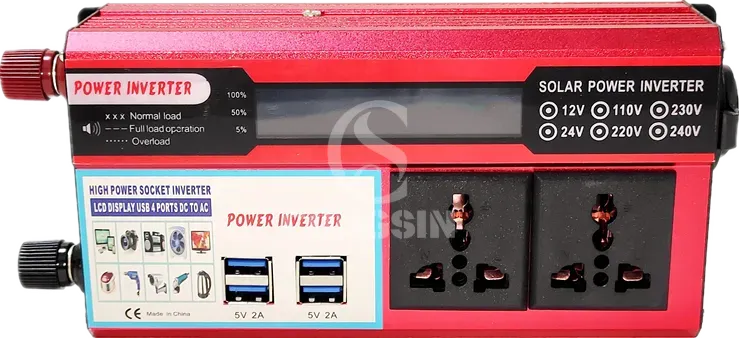
Congsin 500W Modified Sine Wave Inverter with LCD Display of Off Grid System Solar Power Inverter
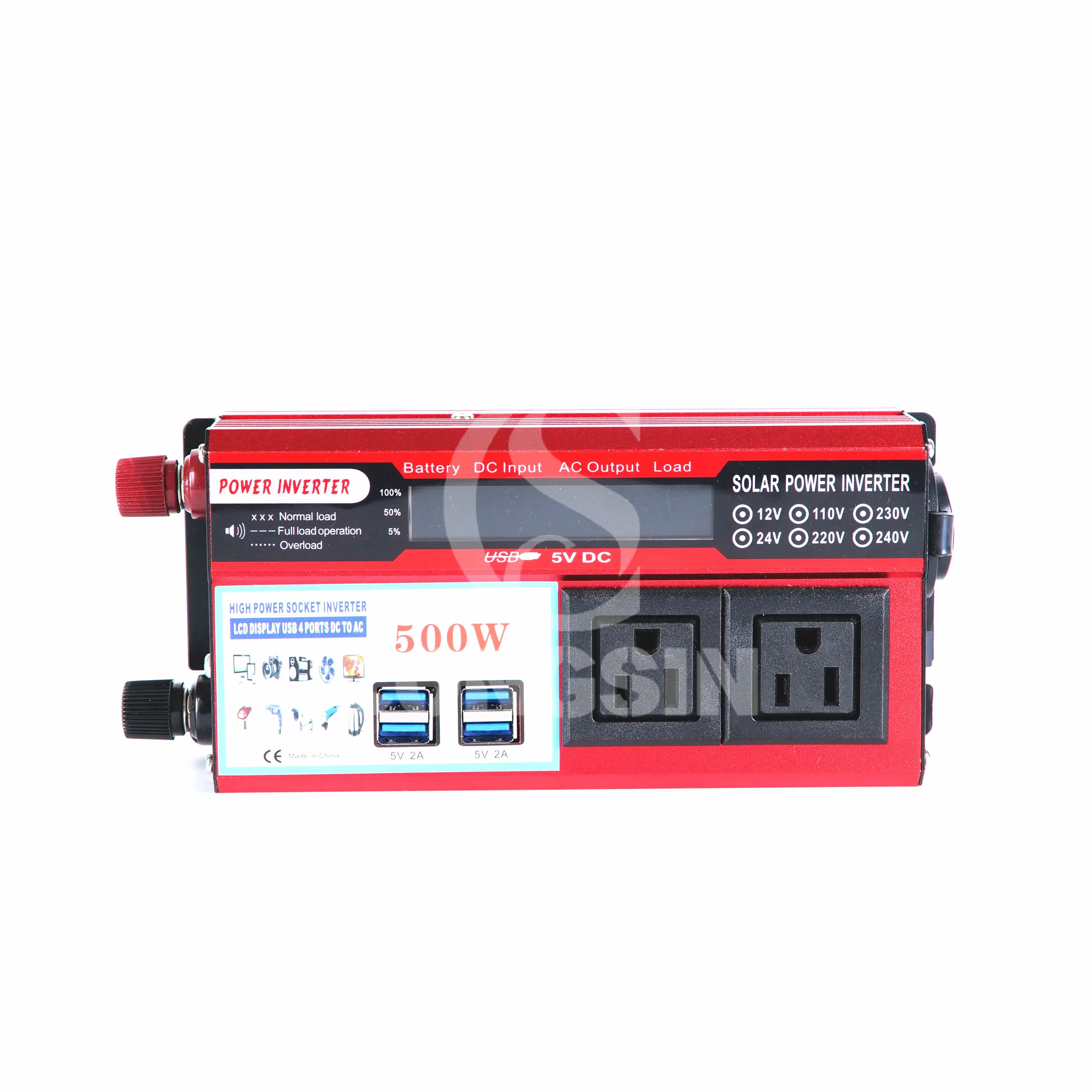
Congsin 500W modified sine wave power inverter US sockets 4 USB ports LCD display off grid
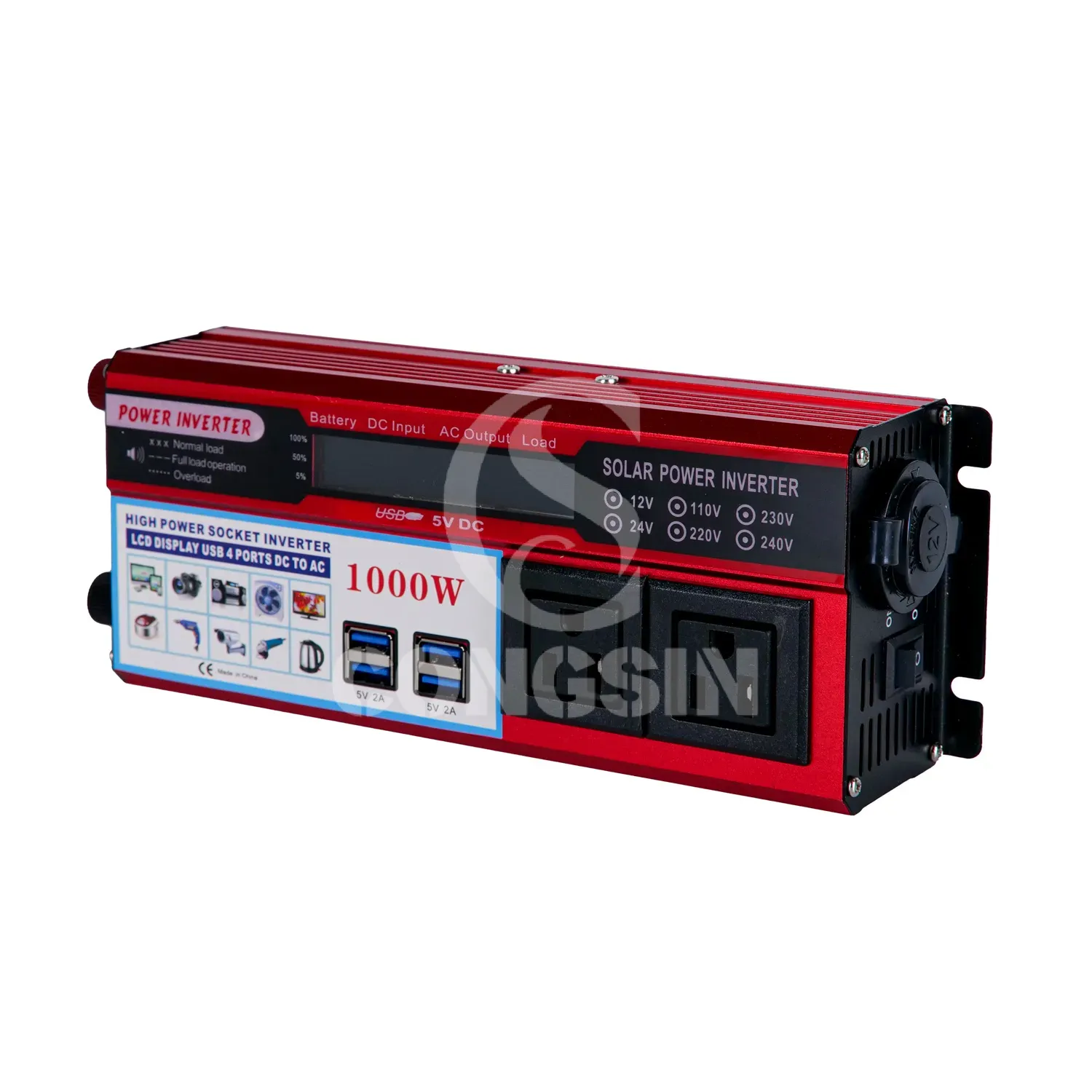
Congsin 1000W modified sine wave inverter with American Sockets and Lcd display portable 12V car RV
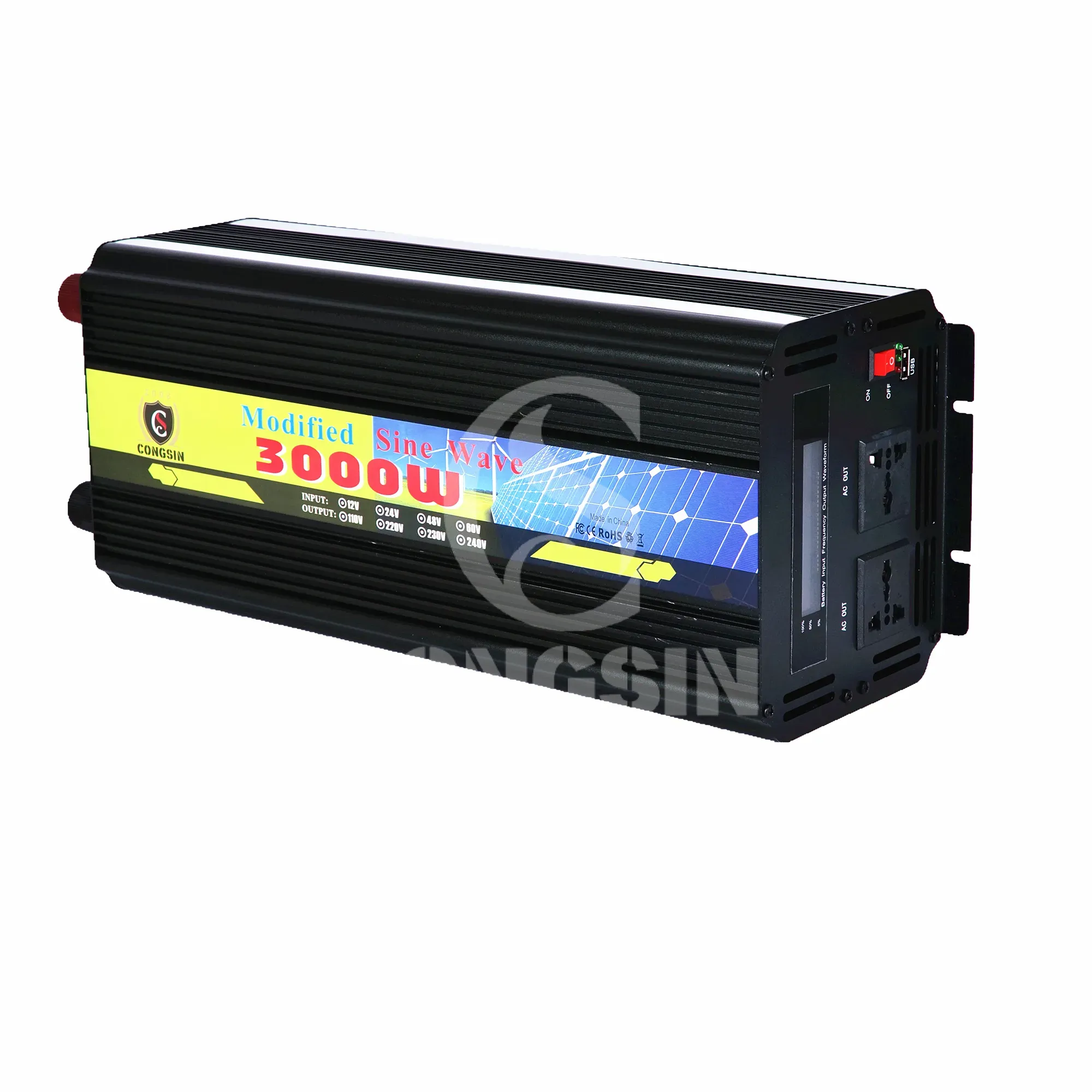
Congsin Full Power 3000W Modified Sine Wave Inverter Peak Power 6000W with LCD Display RV Solar

CONGSIN is a trusted OEM factory for power inverters, solar charge controllers, and DC converters. Reliable solutions for global B2B buyers.
 High Quality
 7/24 Service
 Guaranteed Warranty
© 2025 Congsin. All Rights Reserved.